



The ritual of sacrifice is an important duty that must be performed by individuals who meet certain criteria in our religion. So, for whom is the sacrifice obligatory, and what exactly are the criteria for being obligated to perform the sacrifice? For a person to be held responsible for sacrificing an animal, they must meet the conditions of the sacrifice threshold, which is considered the minimum standard of wealth. (For more detailed information on the definition and nature of the sacrifice, please refer to our internal link titled “What Is Sacrifice?” ) In this guide, we will examine the conditions of the sacrifice, who is obligated to perform it, and the details of the wealth calculation.
Table of Contents
- Who Is Required to Perform the Sacrifice? Basic Requirements for the Sacrifice
- The Status of a Traveler: The Obligation to Sacrifice During Travel
- What Is the Threshold for Sacrificial Offerings? (Detailed Analysis)
- Views on Sacrifice for Children and the Mentally Ill
- Order of Succession in the Event of Death
- Frequently Asked Questions (FAQ)
The Conditions and Obligations of Sacrificial Slaughter
For the sacrifice of an animal to be obligatory for a person, certain specific conditions must be met simultaneously.- It is obligatory for Muslims who are wealthy enough to be required to pay fitra to sacrifice an animal.
- The person performing the sacrifice must be free.
- The person must be a resident (not a traveler).
- It is obligatory for both Muslim men and women who meet these conditions to perform the sacrifice.
| Condition | Description |
|---|---|
| Becoming a Muslim | Sacrifice is a form of worship specific to Muslim men and women. |
| To Be Free | It is obligatory for those who are free (not slaves). |
| To Be a Resident | It is obligatory for those who are not traveling, that is, for non-travelers. |
| Becoming Rich | It refers to a person possessing the required amount of wealth to be eligible to pay the fitra. |
The Ritual of Sacrifice During Travel and While on the Road
Islam has provided various concessions for those who are traveling. The ritual of sacrifice is also subject to one of these concessions.- Sacrifice is not obligatory for a traveler.
- A traveler is someone who sets out on a journey of at least 90 km.
- If a traveler voluntarily sacrifices an animal as a supererogatory act, this is permissible.
- If a person who is a resident purchases a sacrificial animal and then sets out on a journey before the time for sacrificing has passed (before sunset on the third day of the festival), it is permissible for that person to sell the animal if they are wealthy, and it is not obligatory for them to sacrifice it.
- However, if a person in the same situation is poor, it is not permissible for them to sell the animal they have purchased for the purpose of sacrificing it, since the obligation to perform the sacrifice applies to that animal.
What Is the Threshold for Sacrificial Offerings? (Detailed Analysis)
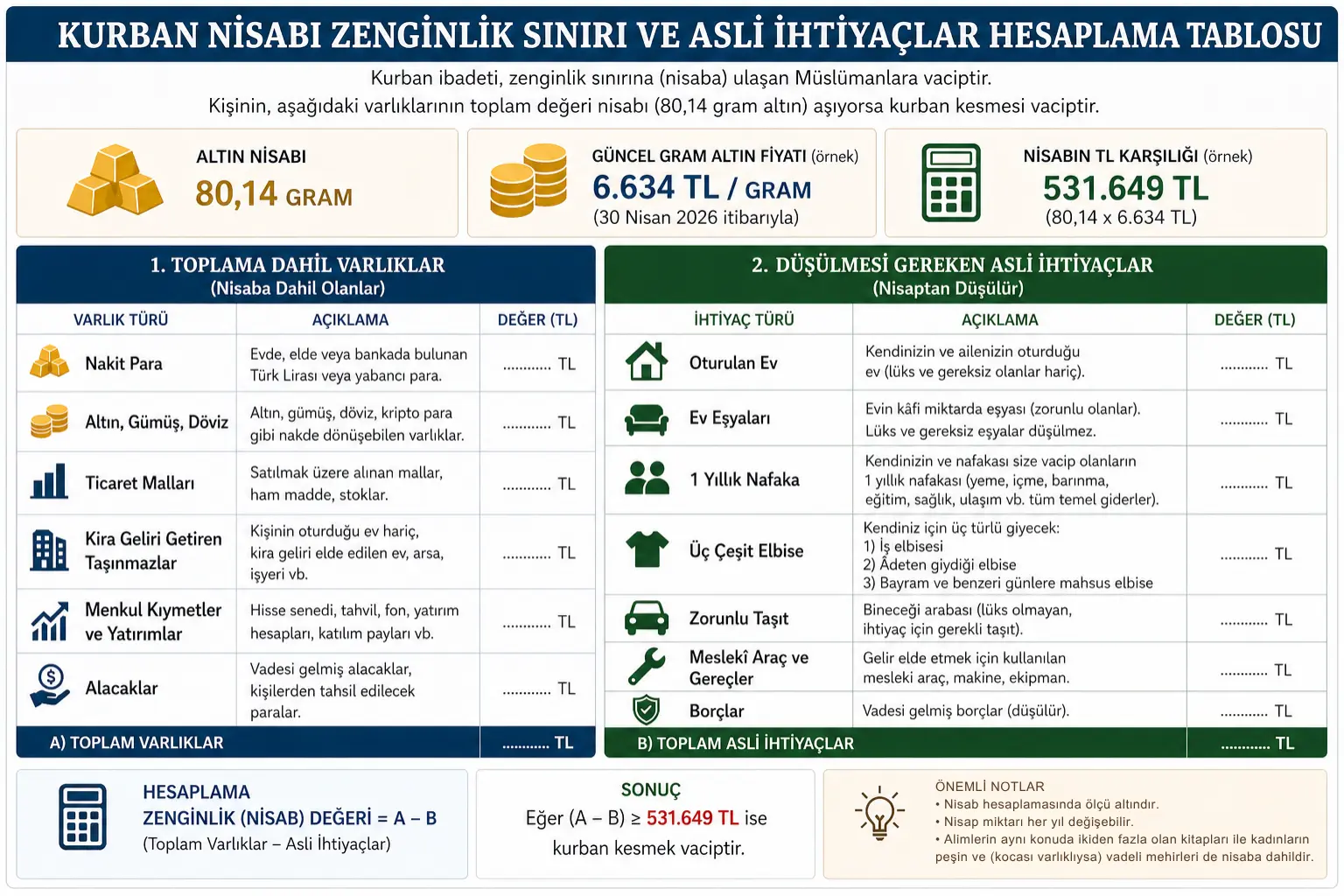
- The threshold for the sacrifice (the amount of wealth required for the sacrifice to become obligatory) refers to a person having enough wealth to make the fitra (charity) obligatory.
- This property does not need to be of a nature that can increase in value through trade, as is the case with the nisab for zakat.
- It is also not required that one year have passed since the purchase of this item.
- If a person possesses 80.14 grams of gold or an equivalent amount of another asset in excess of their basic and essential needs, it becomes obligatory for that person to sacrifice an animal once a year.
- Even if a person becomes wealthy after the days designated for sacrificing an animal have ended, it is obligatory for them to perform the sacrifice immediately.
What Are Basic and Essential Needs?
When calculating the wealth threshold (nisab for zakat), certain properties and items necessary for basic subsistence are not included in the calculation.- A person’s home and a sufficient amount of household goods are considered basic necessities.
- The car he will be driving is considered a basic necessity.
- A person’s clothing consists of three essential categories: work clothes, everyday attire, and clothing reserved for holidays and similar occasions.
- This includes one year’s worth of maintenance for himself and those for whom he is obligated to provide support (or, according to another valid opinion, one month’s worth).
- On the other hand, books by a single author that number more than two are considered valid for the nisab and are included in the nisab.
- Both the immediate (prepaid) dowry of women and the deferred (postponed; not prepaid) dowry to be paid by a wealthy husband are included in the nisab.
Views on Sacrifice for Children and the Mentally Ill
Classical sources of Islamic jurisprudence contain differing legal opinions regarding the obligation to offer a sacrifice for children who have not yet reached puberty and those who lack mental capacity.- According to Imam al-Azam and Abu Yusuf, a person does not need to be of sound mind or of legal age to be obligated to offer a sacrifice.
- Accordingly, the father or guardian of an insane person or a child who has not yet reached puberty sacrifices an animal on their behalf and feeds them the meat.
- The portion remaining from what a child or an insane person has eaten may be exchanged for an item that is of use to them (such as clothing).
- Since the sacrifice is a financial obligation, a child who is wealthy must also perform the sacrifice.
- Furthermore, according to *Zâhiru’r-rivâye*, on which the fatwa is also based, it is recommended for a free, resident Muslim who possesses the nisab to offer a sacrifice on behalf of his or her young children.
- According to another tradition transmitted by Imam Hasan from Abu Hanifa (Imam al-Quduri preferred this tradition), it is obligatory for a person to sacrifice an animal on behalf of their young child.
Order of Succession in the Event of Death
A Muslim may bequeath that various religious obligations be paid before his or her death. If a person whose death is imminent and who has outstanding financial obligations related to worship bequeaths that one-third of his or her estate be used to pay these obligations, the following procedure is followed:- If one-third of your assets is sufficient to cover all these debts, you must pay them all off.
- However, if one-third of one’s assets is insufficient to cover all debts, repayment begins with the zakat; first the zakat is paid, then the hajj.
- Next, the fitr charity is paid, followed by the expiation for breaking an oath.
- Finally, if there is any food left over, the sacrificial animal is slaughtered.
Frequently Asked Questions (FAQ)
Exactly who is required to perform the sacrifice?
The sacrifice is obligatory for Muslims who are free, of sound mind (having reached puberty), not traveling (resident), and wealthy—that is , possessing at least the nisab amount (80.14 grams of gold or its equivalent) in wealth beyond their basic necessities.
Am I required to sacrifice an animal while traveling?
No, according to Islamic jurisprudence, it is not obligatory for those who travel at least 90 km and are considered travelers (müsâfir) to sacrifice an animal. However, those who wish to do so may sacrifice an animal of their own volition with the intention of performing a supererogatory act of worship.
Are a home and a car included when calculating the wealth threshold (nisab)?
No, when calculating the wealth threshold, the home in which the individual resides, household goods, clothing worn for daily use or work, the vehicle they drive, and the annual maintenance costs for dependents are considered essential needs and are not included in the calculation. The remaining assets must be equivalent to 80.14 grams of gold.