


The Islamic calendar—also known as the Hijri calendar—is a lunar calendar that determines the religious practices of Muslims, as well as their holy days and nights, festivals, and commemorative nights. Unlike the solar-based Gregorian calendar, this system is based on the moon’s movements; it was officially established during the time of Caliph Umar and takes the year 622—the year the Prophet Muhammad migrated from Mecca to Medina—as its starting point. Understanding the Islamic calendar means grasping all the key milestones of Muslim religious life, from Ramadan to Eid al-Adha, and from the sacred months to the three months of fasting.
What Is the Islamic Calendar (Hijri Calendar)?
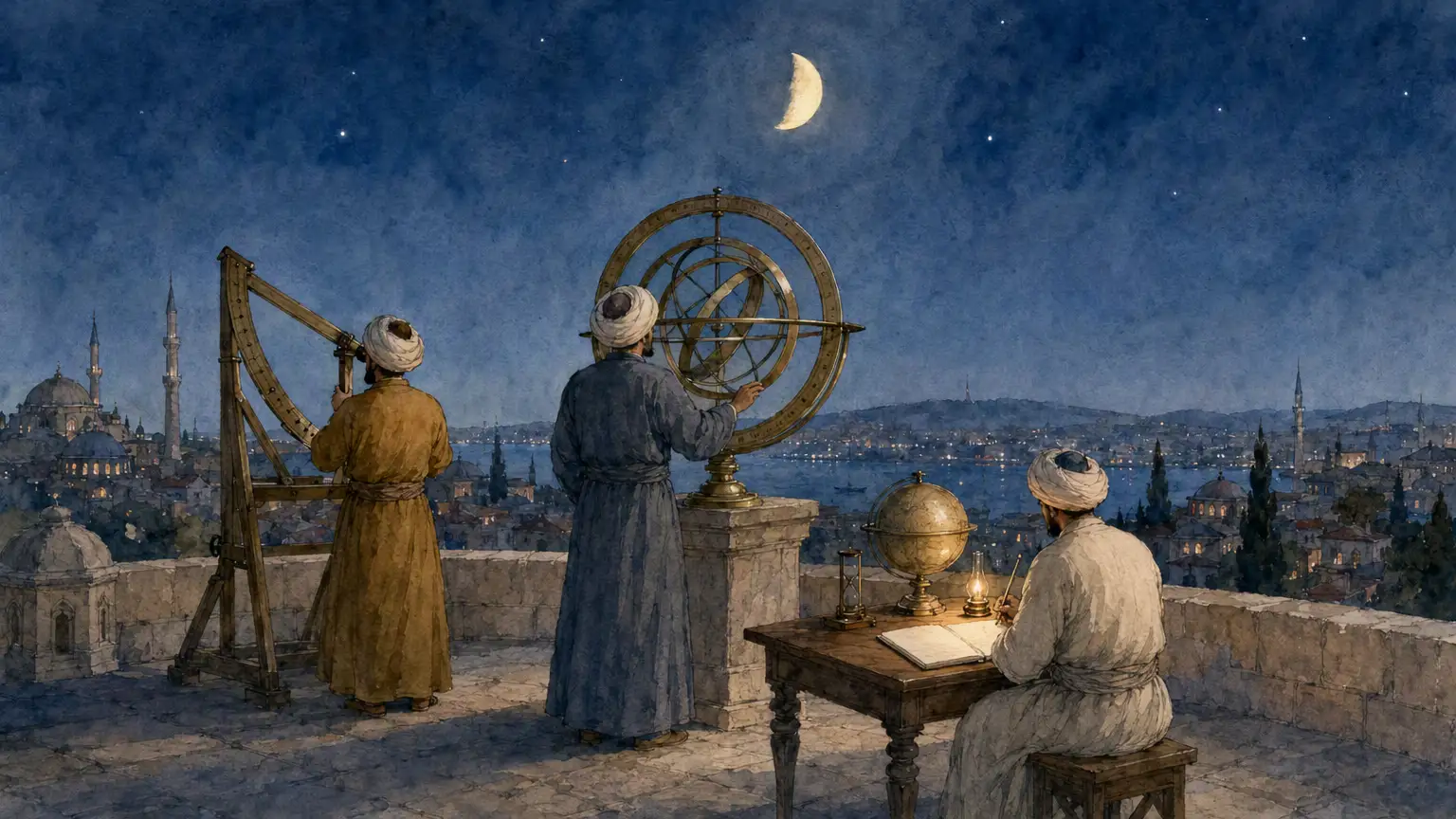
The Islamic calendar is a lunar calendar. The beginning of each month is determined by the first sighting of the new crescent moon. Since it takes the moon approximately 29.5 days to complete one orbit around the Earth, each month has either 29 or 30 days, for a total of 354 or 355 days in a year.
This system was implemented during the caliphate of Umar ibn al-Khattab at the suggestion of Ali ibn Abi Talib; the year 622 CE, when the Prophet’s Hijrah took place, was designated as the starting point. The first official day of the calendar is the first day of the month of Muharram.
What Is the Difference Between the Gregorian and Islamic Calendars?
The main differences between the two calendars can be summarized as follows:
- Basic system: The Gregorian calendar is based on the movement of the Sun, while the Islamic calendar is based on the movement of the Moon.
- Length of the year: The Islamic year is 354–355 days long, while the Gregorian year is 365–366 days long.
- Seasonal connection: The Islamic calendar is not tied to the seasons; therefore, Ramadan can fall in either summer or winter.
- Drift rate: There is a drift of approximately 10–11 days each year; a full cycle is completed approximately every 33 years.
Months of the Islamic Calendar: 12 Months, Their Names and Meanings
The Islamic calendar consists of 12 months. Each month has a specific name and a deep-rooted meaning. The months of the Hijri year, from the first to the twelfth, are listed in order as follows:
- Muharrem — It means “forbidden.” It is one of the four sacred months. The 10th day is known as Ashura.
- Safer — It means “empty” or “desolate.” It is known as the month during the pre-Islamic era when the Arabs would leave their homes empty to go to war.
- Rabi' al-Awwal — This means "early spring, abundance." It is the month in which the Prophet Muhammad was born; the 12th night of the month is celebrated as the Prophet's Birthday.
- Rabi' al-Awwal — It means "late autumn." It symbolizes the end of the season of abundance and prosperity.
- Cemaziyelevvel — It means “the first cold, the first barren soil.”
- Cemaziyelahir — It means “the last cold, the last barren.”
- Recep — It means “respect” or “reverence.” It is one of the Four Sacred Months and marks the beginning of the “Three Holy Months.” Regaib Night (the first Friday night) and Miraj Night (the 27th night) fall during this month.
- Sha'ban — It means "to disperse" or "to part." It is the second of the Three Holy Months; its 15th night is known as the Night of Berat.
- Ramadan — It means “to burn, to be hot.” The Holy Quran began to be revealed during this month. The 27th night is Laylat al-Qadr.
- Shawwal — It means “risen, increased.” The first day marks the beginning of Eid al-Fitr.
- Zilkade — It means “the month of peace and rest.” It is the third of the four sacred months.
- Zilhicce — means “the month of Hajj.” It is the last of the four sacred months. The 9th day is the Day of Arafat, and the 10th through 13th days mark Eid al-Adha.
What Are the Sacred Months?
The four months of Muharram, Rajab, Dhu al-Qi'dah, and Dhu al-Hijjah are known as the “Sacred Months.” These months are sacred periods during which warfare and bloodshed are prohibited. In pre-Islamic Arab society, trade took place during these months, and people from distant regions would gather safely; Islam endorsed and continued this tradition.
What Are the Three Holy Months? Rajab, Sha'ban, and Ramadan
The months of Rajab, Sha’ban, and Ramadan are collectively known as the “Three Holy Months.” This period begins with the start of Rajab and is regarded as a special time of spiritual focus and preparation for worship for Muslims. Four of the five "Kandil" nights (Regaib, Miraj, Berat, and Qadr) fall within this three-month period. Detailed information about the Kandil nights and the dates of the blessed days in 2026 can be found on our "Kandil Nights and Blessed Days Guide " page.
The Importance of Time in Islam
The Holy Quran attaches great importance to the concept of time. The Chapter of Time (Surah al-Asr) swears by time itself, while the Chapter of Power (Surah al-Qadr) declares that a specific night is superior to a thousand months. This demonstrates that, in the Islamic faith, not all times are equal; certain days and nights are distinguished from others in terms of spiritual value.
The message of the Holy Quran is structured according to the Islamic calendar. The rituals of Hajj, fasting, zakat, and Eid are determined by this calendar. For this reason, the Islamic calendar is not merely a tool for measuring time; it is a guide that regulates the worship life of Muslims and marks special, meaningful occasions.
Islamic scholars describe these blessed nights as “seasons of virtue.” It is said that acts of worship such as prayer, repentance, charity, and recitation of the Quran hold greater spiritual significance during these nights than at other times. On the other hand, the fundamental requirement for showing respect for these times is to refrain from sinning.
In addition, fundamental Islamic practices such as the sacrifice ritual and zakat are performed according to the Islamic calendar; the timing and calculations for these practices are directly linked to this calendar.
Frequently Asked Questions
Why is the Islamic calendar shorter than the Gregorian calendar?
The Islamic calendar is based on the moon’s movements. The moon completes one orbit around the Earth in approximately 29.5 days; therefore, the Hijri year lasts 354–355 days. It is approximately 10–11 days shorter than the Gregorian calendar, which is based on the solar year. Because of this difference, Ramadan and other holy days fall on different dates in the Gregorian calendar each year.
When was the Islamic calendar established?
The Islamic calendar was officially established during the caliphate of Umar ibn al-Khattab, following a proposal by Ali ibn Abi Talib. The year 622 CE, when the Prophet Muhammad migrated from Mecca to Medina, was adopted as the starting point; the first day of the month of Muharram in that year was designated as the first day of the calendar.
When does the Islamic New Year fall in 2026?
The start of the Islamic year 1448 corresponds to Tuesday, June 16, 2026, in the Gregorian calendar. The Islamic New Year falls approximately 10–11 days earlier each year.
Which months are the sacred months, and why are they important?
The four months of Muharram, Rajab, Dhu al-Qi'dah, and Dhu al-Hijjah are known as the “Sacred Months.” War and bloodshed have been prohibited during these months since pre-Islamic Arab tradition, and Islam has upheld this tradition. Furthermore, since the Hajj pilgrimage is performed during the month of Dhu al-Hijjah, this month holds special significance in the Muslim world.