


How Did Waqfs Function in the Ottoman Empire? Waqf Deeds, Endowments, and Charitable Institutions
In the Ottoman Empire, waqfs were independent institutions established when a benefactor permanently set aside his or her property for the sake of Allah, with their income derived from their own assets. Facilities such as mosques, madrasas, soup kitchens, hospitals, and bridges were built in this manner and operated for centuries using income derived from rent and land. The terms of their establishment were set forth in a document called a vakfiye.
What Does “Vakıf” Mean? The Meaning of the Word and Its Religious Basis
To understand the concept underlying waqfs in the Ottoman Empire, one must start with the word itself. The word “waqf” comes from Arabic and means “to confine” or “to set aside.” In the terminology of Islamic jurisprudence (fiqh), according to Imam al-A’zam Abu Hanifa, a waqf is the act of donating the benefits of a property while retaining ownership of the property itself. According to the two Imams (Imam Abu Yusuf and Imam Muhammad), however, it means dedicating a property to the ownership of Allah the Almighty.
InKudûrî’s *Book on Waqfs*, three conditions are listed for the validity of a waqf:
- The fact that the endowed property is free from any rights held by another person,
- The founder must not stipulate any of the endowment’s benefits for himself,
- The endowment is perpetual, that is, it has no fixed term.
The foundation of the endowment is cited as verse 92 of Surah Al-Imran in the Holy Quran:
“You will never attain true goodness unless you spend from the things you love (in the way of Allah). Whatever you spend, Allah knows it fully.” (Surah Al-Imran, verse 92)
The hadith states that when a person dies, the record of their deeds is closed, with three exceptions: ongoing charity, knowledge that benefits others after their death, and a righteous child who prays for them. A waqf is considered the institutionalized form of the first of these three exceptions.
How Were Waqfs Established and Oversee in the Ottoman Empire?
A waqf was established through a document called a vakfiye. The vakfiye specified in detail who had established the waqf and when, which properties had been bequeathed as sources of income, and who would administer the waqf, under what conditions, and for how long. The document was registered in the presence of the qadi, thereby granting the waqf legal personality.
Each waqf had its own charter and its own operating procedures. Except in exceptional circumstances, the terms and purpose of the waqf could not be altered by anyone. The administrative staff generally consisted of the following officials:
- Trustee — the administrator of the endowment; he was responsible for managing it in accordance with the terms of the endowment deed.
- Endowment clerk — was responsible for the endowment’s financial management and correspondence.
- Câbî — he collected the endowment's revenues.
- Nâzır — was responsible for overseeing the foundation.
The state did not leave endowments to their own devices. Whether they were managed in accordance with the terms of the endowment deeds and whether their annual accounts were properly maintained were constantly monitored by endowment supervisors and the judicial system. The legal principle was also in this vein: regardless of whether the founder had stipulated otherwise, the first expense to be covered from the endowment’s income was the endowment’s own maintenance and repair.
An example illustrating the seriousness of this oversight comes from the reign of Mehmed the Conqueror. Mehmed dissolved a large portion of the waqfs—whose revenue came from state-owned land—and incorporated their revenues into the treasury. In this way, he prevented some founders from establishing waqfs solely to preserve their family wealth and stopped the unchecked proliferation of waqfs, which had been depleting state resources.
Where Did the Endowment's Income Come From? Akar, the Money Endowment, and Icâreteyn
In the Ottoman Empire, waqfs did not receive a share of the state budget; they generated their own income from their own properties. These income-generating properties were called “akar.” The Grand Bazaar, built by Sultan Mehmed the Conqueror, is the best-known example of this: the rental income from the shops there was allocated to cover the expenses of charitable institutions, primarily the Hagia Sophia Complex. The revenues of the Fatih Complex, meanwhile, consisted of three main categories: agricultural income, rental income, and jizya (poll tax) revenue.
The Ottomans added two significant innovations to this classical structure:
- Monetary endowments. Establishing a real estate endowment was something only high-income individuals could do. Monetary endowments enabled even small savers to participate in the endowment sector. Trade guilds, Janissary units, neighborhoods, and villages were able to come together to establish endowments. In an environment where interest was prohibited, these endowments became a source of credit to meet the needs of the productive sector.
- Ijaratayn (double rent). Most endowments that lost their buildings due to fire, earthquake, or flood did not have the funds to rebuild them. Under the Icâreteyn system, an individual who rebuilt the destroyed building with his own funds would sell it to the endowment; instead of receiving the full purchase price, he would leave a portion of it with the endowment as a “muaccele” (advance payment) and lease the facility back from the endowment on a long-term basis. The endowment would thus regain the facility it had lost at a cost well below its normal value.
What Would a Waqf Complex Do? The Example of the Fatih Complex
A külliye is an architectural complex centered around a mosque and comprising structures such as a madrasa, school, library, hospital, soup kitchen, caravanserai, public bath, and fountain. In the Ottoman Empire, there was no such thing as a külliye without a mosque. Completed in 1470, the Fatih Complex was the largest and most organized külliye built up to that point; its architect was Sinanüddin Yûsuf, also known as Sinan-ı Atîk.
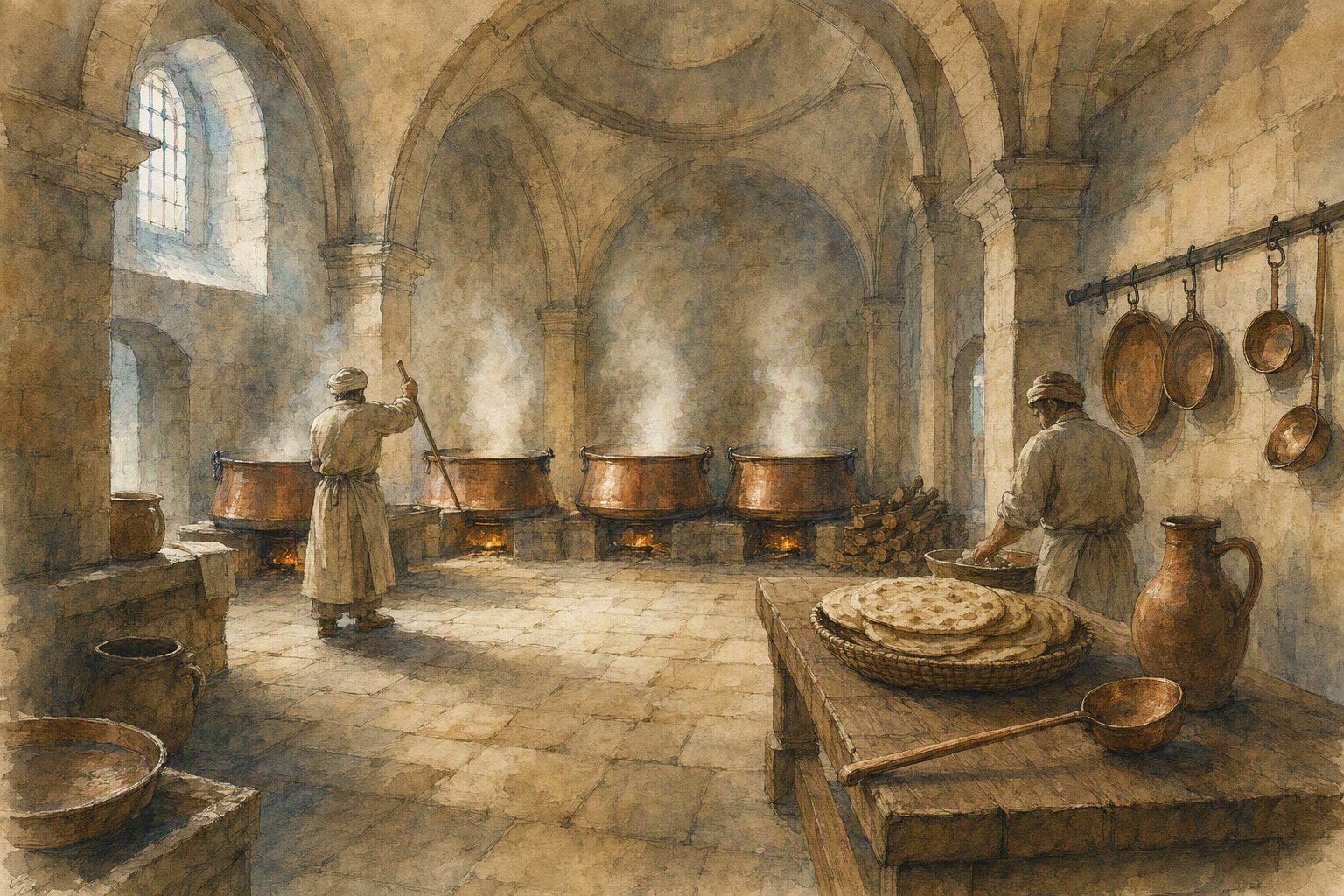
According to its endowment deed, daily life at this complex unfolded as follows:
- Imaret: A total of 1,095 people—600 of whom were students—were served meals each day. The meals included 410 kilograms of mutton per day. Outside of Ramadan, meals were served in the morning and evening; during Ramadan, meals were served only at iftar time.
- Dârüşşifa: No fees were charged to poor patients, while a small fee was charged to wealthy patients. Medicines were prepared at the dârüşşifa; 200 akçe had been allocated for daily needs.
- School: According to the endowment deed, orphans and poor Muslim children were given priority for enrollment.
- Cash assistance: A daily allowance of 40 akçe for food was allocated to the poor in the surrounding area, and 100 akçe was set aside for orphans living in Istanbul. Each infant without parents received a monthly milk allowance of 15 akçe; this payment was transferred to a new child once the original child had outgrown infancy.
- Those Unable to Work: A portion of the complex’s surplus revenue was used in a manner similar to today’s unemployment fund. Of the 60 people who received assistance, 9 were people with disabilities, and the rest were elderly or professionals who were unable to work.
The budgetary discipline of Ottoman waqfs is clearly evident in these records: 85–90 percent of the külliye’s expenditures went toward personnel, food, and maintenance and repair. Nor did all of the revenue remain within the külliye: regular assistance was provided to the Kalenderhane, Molla Gürânî, and Efdalzâde madrasas, and support was given to dozens of mosques.
Ottoman Waqfs in Numbers
| Period and location | Finding |
|---|---|
| 1530–1540, Anatolia Province | The total revenue of the waqfs was 13,641,684 akçe. This revenue was used to operate 112 madrasas, 623 zawiyas, 154 teachers’ residences, and 4 dar al-huffaz; 121 professors and 8,055 staff members received salaries from these same waqfs. |
| 1490, Istanbul | 496 people received salaries from the Fatih Mosque’s imaret, and 457 from the Hagia Sophia endowments. |
| 1597, Silistra Sanjak | Twenty-four percent of the sanjak’s revenue came from endowment income. |
| 18th century | Nearly half of government revenues belonged to endowments; the number of people receiving salaries from endowments had reached 86,915. |
| 1736, Istanbul | According to an inspection report, 322 people were found to be begging in the city, and it was determined that 70 of them were poor enough to resort to begging. In the same century, Paris and London—both with populations of around 500,000—each had groups of 50,000 beggars. |
Frequently Asked Questions
What does “waqf” mean?
In Arabic, the word “waqf” means “to confine” or “to hold.” In Islamic jurisprudence, it refers to the permanent dedication of the benefits of a property for the benefit of others, for the sake of Allah.
What is a vakfiye?
A vakfiye is the founding document of a waqf. This document specifies who established the waqf and when, which properties were bequeathed as sources of income, and who will administer the waqf and under what conditions. It was registered in the presence of a qadi.
Who managed the waqfs in the Ottoman Empire?
The endowment was administered by a trustee in accordance with the conditions specified in the endowment deed. Assisting the trustee were the endowment clerk, who was responsible for correspondence; the tax collector, who collected revenues; and the supervisor, who oversaw the administration. The annual accounts of the endowments were also audited by the judicial system.
What is a monetary foundation?
A cash endowment is a type of endowment established by donating cash capital rather than real estate. It has enabled even small savers to establish endowments; trade guilds, neighborhoods, and villages have used this method to create mutual aid endowments among themselves.
What was the purpose of the imaret?
An imaret is a soup kitchen affiliated with a külliye. It provided daily meals to students, staff, guests, and needy people in the surrounding area. Endowment records show that a total of 1,095 people were served meals each day at the imaret of the Fatih Külliye.
Sources
- Surah Al-i Imran, verse 92 (Elmalılı Hamdi Yazır, The Language of the Quran as the True Religion).
- Hadith regarding ongoing charity: Riyad al-Salihin.
- Abu al-Hasan al-Quduri, The Quduri Sharif Translation, “The Book of Waqf.”
- Mehmet Genç, “The Cornerstone of Social and Economic Life in the Ottoman Empire: Waqfs,” Yedikıta, No. 90, February 2016, pp. 45–49.
- Mustafa Güler, “The Pride of Humanity in Service: Foundations,” Yedikıta, Issue 1, September 2008, pp. 62–65.
- Ahmet Uçar, “Fatih’s Gift to Istanbul: The Fatih Complex and Endowment,” Yedikıta, No. 34, June 2011, pp. 42–47.
- Hilmi Ergin, “Institutions That See the Human Being When They Look: Foundations,” İnsan ve Hayat, no. 34, December 2012, pp. 30–34.
- Selman Kılınç and Hüseyin Güney, “An Unappreciated Treasure: Endowments,” Yedikıta, Issue 66, February 2014, pp. 16–19.