


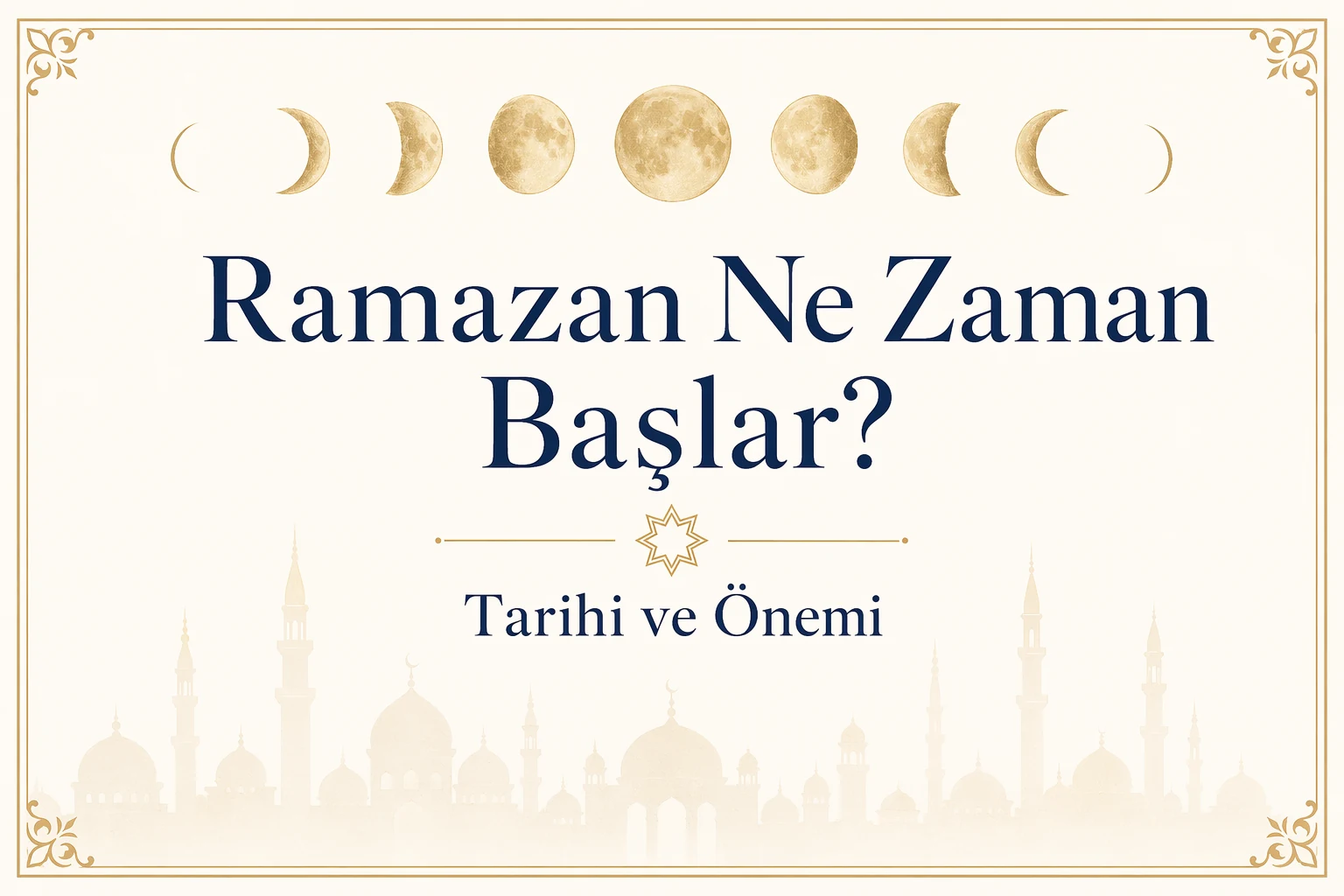
The answer to the question “When does Ramadan begin?” depends not on the solar calendar but on the Hijri (lunar) calendar: The month of Ramadan begins with the first sighting of the new moon following the end of the month of Sha’ban, and it shifts forward by 10–11 days each year in the Gregorian calendar. This article discusses how the start of Ramadan is determined, its historical origins, and its spiritual significance.
When Does the Month of Ramadan Begin? The Relationship Between the Hijri Calendar and the Crescent Moon
Ramadan is the ninth month of the Islamic calendar. Unlike the solar calendar, the Islamic calendar is based entirely on the Moon’s movements; therefore, it does not occupy a fixed position within the seasons and shifts 10–11 days earlier each year compared to the previous year. A lunar month is the period from the first appearance of the crescent moon until the next crescent moon, lasting 29 or 30 days.
This means that Ramadan falls in winter some years and in summer others. Consequently, there is no fixed Gregorian date for “when is Ramadan”; it must be recalculated each year.
What Are "İçtima" and "Rüyet"?
Two fundamental astronomical concepts are used in determining the crescent moon:
- Conjunction: The moment when the Moon and the Sun are aligned as seen from Earth. At this stage, the Moon is not visible to the naked eye.
- Visibility: This refers to the moment after the new moon when the Moon reaches a certain angle and becomes visible to the naked eye as a thin crescent.
According to general consensus, the Moon must be at least 8 degrees away from the Sun for the crescent to be observable. If the crescent cannot be seen in a given region, the current lunar month is rounded up to 30 days, and the following day is considered the beginning of the new lunar month.
Visual Observation or Astronomical Calculation?
Two approaches are debated regarding the determination of the start of the lunar month: direct visual observation of the crescent moon (ru’yat) and modern astronomical calculations. Since today’s technology allows for the Moon’s position to be calculated in advance with extreme precision, many Islamic countries and institutions consider the determination of the start of the lunar month based on scientific data to be sufficient for religious purposes, even if the crescent is not visible to the naked eye. The preference between these two methods may vary from country to country and from institution to institution.
What Is the Historical Significance of the Month of Ramadan?
The most fundamental characteristic that distinguishes the month of Ramadan from other months is that the Holy Quran began to be revealed during this month. The Quran was revealed in its entirety on the Night of Power (Laylat al-Qadr) during Ramadan and was subsequently conveyed to the Prophet (peace be upon him) in parts over a period of 23 years through divine revelation.
For more detailed information about Laylat al-Qadr, please refer to the page titled “Laylat al-Qadr: A Guide to Its Virtues and Recommended Acts of Worship.”
The Ramadan fast was made obligatory for all Muslims in the second year of the Hijra (around February of the year 624 CE). According to tradition, the first obligatory Ramadan fast was observed on February 26, 624. Another event that makes this first Ramadan historically significant is that the Battle of Badr took place on the seventeenth day of that first Ramadan.
The Spiritual and Social Significance of Ramadan
What Is the Purpose of Fasting?
One of the fundamental purposes of fasting is self-discipline. A person tested by hunger and thirst learns to control their physical desires and to strengthen their patience and willpower. In this regard, Ramadan is seen as a period during which individuals turn inward, reflect on themselves, and renew themselves spiritually.
What Are the Social Benefits of Ramadan?
By experiencing hunger and thirst throughout the day, those who fast gain a better understanding of the plight of those in need, which in turn strengthens their sense of empathy. Furthermore, Ramadan is a time when the spirit of solidarity and mutual aid within the community is heightened, and intergenerational values are passed down through shared practices such as iftar meals and suhoor.
Frequently Asked Questions
Does the month of Ramadan begin on the same date every year?
No. Since Ramadan is based on the Islamic (lunar) calendar, it shifts forward by about 10–11 days each year in the Gregorian calendar; therefore, it does not have a fixed start date.
How is the start of Ramadan determined?
On the evening of the 29th day of Sha'ban, the crescent moon is observed. If the crescent is sighted, Ramadan begins the next day; if it is not sighted, the month of Sha'ban is completed to 30 days, and the following day becomes the first day of Ramadan.
Why is Ramadan a special month for Muslims?
The fact that it is the month in which the Holy Quran began to be revealed, that it includes Laylat al-Qadr, and that the act of fasting was made obligatory during this month are the key characteristics that distinguish Ramadan from other months.
Sources
- Muhtasaru’l-Kudûrî — The Chapter on Fasting (Savm)
- Dürretü’n-Nasihin — The Ramadan Section (Sermon 1)
- The Holy Quran, Surah Al-Baqarah (2:183–185)
- General Resources on the Islamic Calendar and Lunar Month Calculations