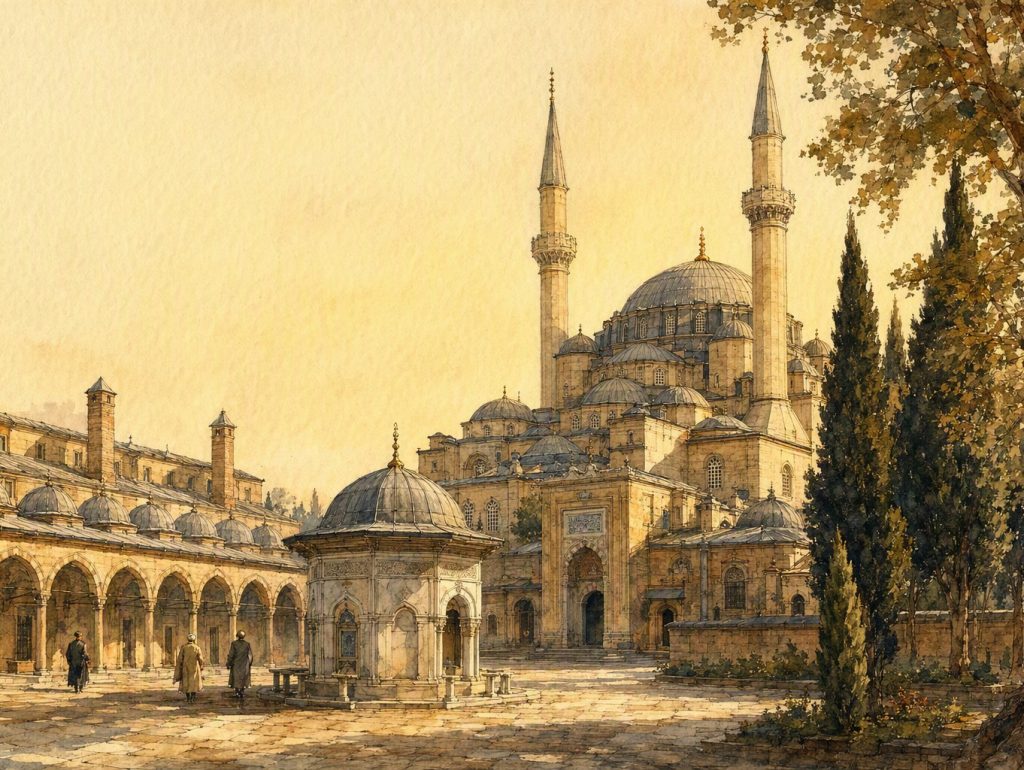



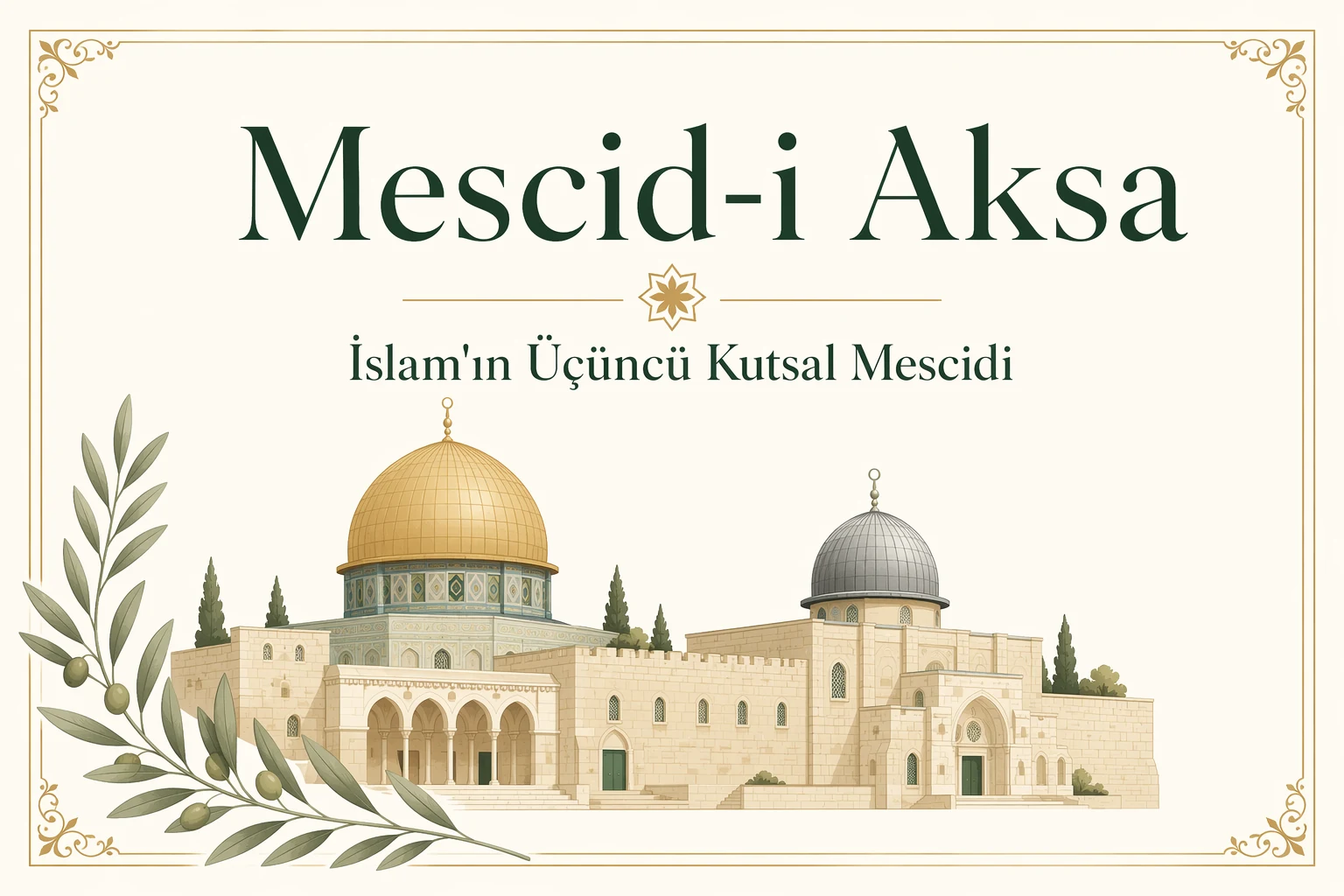
Al-Aqsa Mosque is a holy shrine located in the city of Jerusalem and is considered the third holiest site in Islam, following the Masjid al-Haram and the Masjid al-Nabawi. Its status as the first qibla for Muslims, its role as the site of the Isra and Mi’raj miracles, and its connection to the history of the prophets make the Al-Aqsa Mosque one of the most important sites in the Islamic world. In this article, we examine the religious significance of the Al-Aqsa Mosque, its history, and frequently asked questions about it, drawing on reliable sources.
What Is the Al-Aqsa Mosque, and Where Is It Located?
Al-Aqsa Mosque is a mosque located in Jerusalem at the center of a large complex known as the Haram al-Sharif. The word “Aqsa” means “the farthest” in Arabic; this name derives either from its distance from Mecca or from the fact that it was the farthest mosque in the known world at that time. In addition to the Al-Aqsa Mosque, the complex also includes the Dome of the Rock, which is often confused with the Al-Aqsa Mosque.
What Is the Significance of Al-Aqsa Mosque in Islam?
The significance of Al-Aqsa Mosque in Islam is based primarily on the miracle of the Isra and Mi’raj. The first verse of Surah Al-Isra states that the Prophet Muhammad (peace be upon him) was taken from the Sacred Mosque (Masjid al-Haram) to Al-Aqsa Mosque one night: “Glory be to Allah, who took His servant Muhammad one night from the Masjid al-Haram to the Masjid al-Aqsa. He is free from all defects and partners.” This journey is called the Isra, and the subsequent ascension to heaven is known as the Mi’raj.
The Miracle of the Isra and Mi'raj
According to tradition, after reaching the Al-Aqsa Mosque, the Prophet (peace be upon him) ascended from there to the seven heavens and was granted an audience with Allah. For this reason, the Al-Aqsa Mosque is regarded not only as a place of worship but also as the starting point of one of the greatest miracles of the Islamic faith.
Furthermore, Jerusalem and its surroundings are the lands where prophets such as Moses (peace be upon him) and Jesus (peace be upon him) spent a significant part of their lives. This is one of the main reasons why the Al-Aqsa Mosque is considered sacred not only in Islamic history but also by the three Abrahamic religions.
The Hadith of the Three Holy Mosques and the Location of Al-Aqsa Mosque
Our Prophet (peace be upon him) stated in a well-known hadith: “One should not travel to visit any mosques other than these three: the Sacred Mosque (Masjid al-Haram), this mosque of mine (Masjid al-Nabawi), and Bayt al-Maqdis (Masjid al-Aqsa).” This hadith grants Masjid al-Aqsa a special status in Islam and identifies it as one of the three mosques for which one may travel specifically to visit.
It is reported that, in terms of merit, a prayer performed at the Masjid al-Haram is considered equivalent to one hundred thousand prayers performed at other mosques, while a prayer performed at the Masjid al-Nabawi is equivalent to one thousand prayers. Although the Al-Aqsa Mosque is mentioned as the third mosque in this ranking, it is noted that acts of worship and charitable deeds performed there also yield manifold rewards.
King Solomon (peace be upon him) and the Construction of the Al-Aqsa Mosque
According to another account, when Solomon (peace be upon him) completed the construction of the Al-Aqsa Mosque, he made three requests of Allah. One of these was that anyone who came to this mosque with the sole intention of praying should return purified of their sins. This account demonstrates that the Al-Aqsa Mosque has been regarded as a spiritual center for centuries.
When Does the History of Al-Aqsa Mosque Begin?
Following the conquest of Jerusalem in 638 during the reign of Caliph Umar (may Allah be pleased with him), the first mosque was built there; the structure of the Al-Aqsa Mosque (Qibla Mosque), which stands today, took shape largely during the Umayyad period, under Caliph Walid I (approximately 705–715), and was rebuilt in subsequent periods due to earthquakes. One of the most well-known structures within the complex, the Dome of the Rock, was commissioned by the Umayyad Caliph Abd al-Malik ibn Marwan between 687 and 691.
The Difference Between the Dome of the Rock and the Al-Aqsa Mosque
The Dome of the Rock is a separate structure, known for its golden dome, built atop the sacred rock from which it is believed that the Prophet Muhammad (peace be upon him) ascended to heaven during the Mi’raj. The Al-Aqsa Mosque, on the other hand, is the main mosque building located to the south of this complex, where Friday prayers are held. Although the two are often confused with one another among the general public, they are both part of the same Haram al-Sharif compound.
Was the Al-Aqsa Mosque the First Qibla?
Yes, Al-Aqsa Mosque is the first qibla of Muslims. For approximately 16–17 months after the Hijra, prayers were performed facing Jerusalem—that is, toward Al-Aqsa Mosque—after which the qibla was changed to the Kaaba in Mecca. This period is regarded as a significant turning point that cemented the Al-Aqsa Mosque’s central role in Islamic history.
Frequently Asked Questions
Where is the Al-Aqsa Mosque located?
Al-Aqsa Mosque is located in the city of Jerusalem, within the large complex known as the Haram al-Sharif.
Are the Al-Aqsa Mosque and the Dome of the Rock the same structure?
No, they are two separate structures. While the Dome of the Rock is a structure built over the Sacred Rock, the Al-Aqsa Mosque is the main mosque building of the complex. Both are located within the same Haram al-Sharif compound.
Why is Al-Aqsa Mosque so important in Islam?
Al-Aqsa Mosque holds great significance in Islam because it is the first qibla of Muslims, the site where the miracles of the Isra and Mi'raj took place, and one of the three holy mosques to which pilgrimages may be undertaken.
Sources
- The Holy Quran, Surah Al-Isra (17:1)
- Dürretü’n-Nasihin — The chapter on “The Night Journey and Ascension” (Al-Aqsa Mosque / Bayt al-Maqdis)
- Sahih al-Bukhari and Muslim — The Hadith of the “Three Mosques”
- The Dome of the Rock and Al-Aqsa Mosque During the Umayyad Period (academic article)